Learning to write a new letter takes more than simply seeing it on an alphabet chart. Young children need opportunities to look at the letter, follow its shape, practice its formation, and eventually try writing it independently.
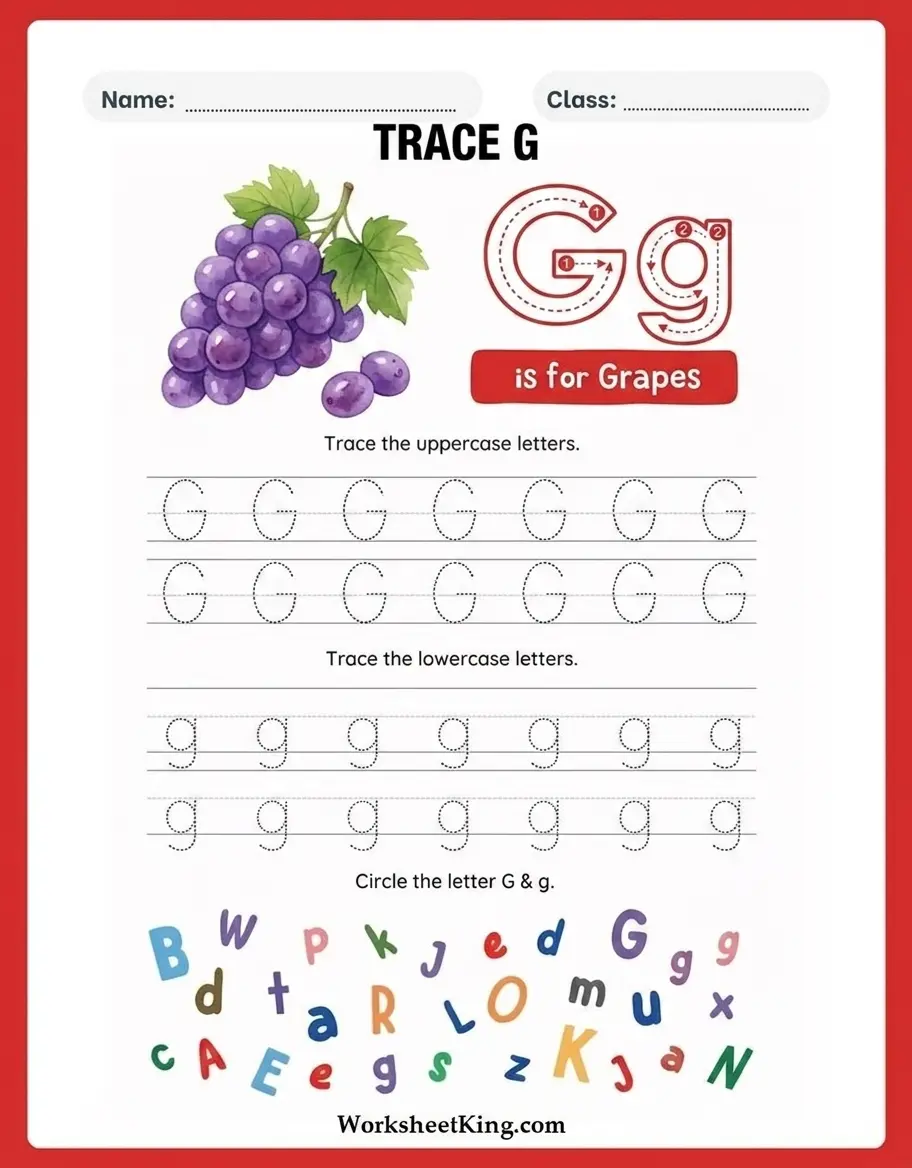
These Letter G tracing worksheets give preschool and kindergarten learners focused practice with both uppercase G and lowercase g. The worksheet collection includes guided tracing and writing practice, along with letter-related pictures that can help connect the letter with familiar words.
The pages can be useful for parents looking for extra handwriting practice at home, teachers preparing literacy activities, or homeschoolers building a simple alphabet routine. Instead of asking children to write the letter from memory right away, tracing provides a visual path to follow first and gradually builds confidence with letter formation.
What Are Letter G Tracing Worksheets?
Letter G tracing worksheets are printable alphabet practice pages designed to help children learn how to recognize and form the letter Gg.
A good tracing activity gives children a model to follow rather than expecting them to remember the entire shape immediately. As they trace, they begin paying attention to where the letter starts, how its lines and curves move, and how the finished letter should look.
The Letter G worksheets on this page include practice with both uppercase G and lowercase g. The collection also includes guided formation exercises and opportunities for additional writing practice.
For young learners, this makes tracing a useful bridge between simply recognizing G and being able to write it independently.
What Children Can Learn With These Worksheets
Letter tracing is a small activity, but it can support several early literacy and handwriting skills at the same time.
Children can practice:
- Uppercase and lowercase letter recognition — learning that G and g represent the same alphabet letter in different forms.
- Letter formation — following a model to understand the shape of G and g.
- Stroke control — practicing controlled pencil movements along a guided path.
- Handwriting readiness — becoming more comfortable using a pencil or crayon for purposeful writing.
- Visual attention — noticing the curves, lines, and overall structure of the letter.
- Alphabet familiarity — reinforcing the position and identity of G within the alphabet.
- Beginning-sound connections — talking about familiar G words while children work with the letter.
The worksheets also include pictures connected with the letter G, such as grapes, grasshopper, and glue, giving parents and teachers an easy opportunity to talk about words beginning with G while children practice.
What Is Included in the Letter G Tracing Worksheets?
The Letter G tracing collection includes several types of practice rather than relying on one repeated worksheet design.
Children can find activities focused on:
Uppercase G Tracing
Large uppercase G models give beginning writers an easy-to-see shape to follow. Guided examples can help children become familiar with the formation of the capital letter before they move toward less-supported writing.
Lowercase g Tracing
Children also practice lowercase g, giving them exposure to the lowercase form they will encounter frequently in books and everyday writing.
Guided Letter Formation
Some of the worksheets provide step-by-step or guided lines that show children how to approach letter formation. This can be particularly helpful when a child is still developing the muscle memory needed for handwriting.
Trace-and-Write Practice
The collection also includes trace-and-write practice, giving children opportunities to move from following a model toward producing the letter themselves.
Letter-Related Pictures
Pictures associated with G words, including grapes, grasshopper, and glue, can add a simple vocabulary and beginning-sound connection to the handwriting activity.
Because individual pages can have different purposes, parents and teachers can choose a page based on whether a child needs more guided tracing or additional independent practice.
Who Can Use Letter G Tracing Worksheets?
Preschool Children
Letter G tracing worksheets can work well for preschool children who are beginning to recognize alphabet letters and develop early pencil-control skills.
At this age, keep the activity short and relaxed. A child does not need to complete a large amount of writing in one sitting. A few careful tracing attempts can be more useful than rushing through an entire page.
Kindergarten Children
Kindergarten students can use G tracing worksheets as handwriting practice, literacy-center work, morning work, homework, or extra practice.
For children who already recognize G, the worksheet can provide additional repetition while they work toward writing the letter with less visual support.
Parents
Parents can use the worksheets as a simple activity after reading an alphabet book, during a short home-learning session, or as extra handwriting practice.
Teachers
Teachers can use individual Letter G pages during an alphabet lesson, handwriting practice, small-group instruction, literacy centers, or review activities.
Homeschoolers
For homeschool families, a Letter G worksheet can fit naturally into an alphabet or phonics lesson without requiring a complicated preparation routine.
How to Use a Letter G Tracing Worksheet
A worksheet works best when the child understands what they are practicing. Try this simple routine.
1. Introduce the letter
Show the child uppercase G and lowercase g. Say the letter name clearly and let the child repeat it.
2. Talk about the shape
Before handing over the pencil, point out the general movement used to form the letter. Encourage the child to watch the model rather than rushing through the tracing.
3. Trace slowly
Ask the child to follow the guided lines carefully. Remind them that the goal is controlled movement, not speed.
4. Say G words
Use simple examples such as grapes, grasshopper, and glue. If the worksheet includes a picture, ask the child to identify it and say the word aloud.
5. Move toward independent writing
Once the child is comfortable tracing, encourage them to try writing G or g with less help. Do not worry if the first independent attempts are uneven.
6. Finish with a quick review
Ask, “What letter did we practice today?” Then have the child point to uppercase G and lowercase g.
This creates a short, repeatable learning routine without turning handwriting practice into a long lesson.
Tips for Helping Children Complete the Worksheet
Start with the larger letters. Large models are generally easier for beginning writers to follow than tiny letters.
Let children use a comfortable writing tool. A pencil, crayon, or age-appropriate marker can work depending on the activity and the child’s stage of writing development.
Focus on the process. If a child goes outside the dotted line, simply encourage another attempt. Constant correction can make handwriting practice frustrating.
Use verbal cues. A short cue such as “watch the curve” or “start here” can be easier for a young child to remember than a long explanation.
Connect writing with language. While practicing G, talk about words that begin with G. This turns an isolated handwriting exercise into a broader alphabet-learning activity.
Stop when attention drops. Preschool handwriting does not need to become a marathon. Short, positive practice sessions can make it easier to return to the activity later.
Repeat the letter on another day. Children often need repeated exposure before a letter feels familiar. Rotate the worksheet with other alphabet activities rather than expecting mastery after one page.
Free Printable Letter G Tracing Worksheets
The Superstar Worksheets Letter G collection provides printable practice for children learning uppercase and lowercase G. The page describes the resources as free printable letter materials and includes guided tracing, writing exercises, and letter-related picture practice.
You can use the worksheets for:
- Preschool handwriting practice
- Kindergarten alphabet work
- Home learning
- Homeschool lessons
- Literacy centers
- Extra handwriting practice
- Alphabet review
For printing, check the worksheet preview and your printer settings before producing multiple copies. If your printer offers options such as “fit to page” or “actual size,” choose the setting that preserves the worksheet layout correctly.
For repeated practice, you can also place a printed page inside a page protector and use a dry-erase marker when the worksheet design and writing space make that practical.
Get the Letter G worksheets here:
Letter G Tracing Worksheets
Frequently Asked Questions
What age are Letter G tracing worksheets suitable for?
Letter G tracing worksheets are generally useful for children in the preschool and kindergarten stages who are beginning to learn alphabet recognition and handwriting. The right time depends on the individual child’s fine-motor readiness and familiarity with letters. Some children may enjoy tracing earlier, while others benefit from additional pre-writing practice first.
How can I teach my child to write uppercase G?
Start by showing a clear uppercase G model and let your child watch how the letter is formed. Have them trace a large guided G several times before asking them to write one independently. Keep the instructions short and encourage slow, controlled movements rather than focusing on perfect handwriting immediately.
How can I teach lowercase g?
Introduce lowercase g separately from uppercase G so the child can clearly see the difference between the two forms. Begin with a large model and guided tracing, then gradually move toward independent writing. Talking about G words while practicing can also help reinforce the connection between the letter and its sound.
Are Letter G tracing worksheets good for preschool?
Yes. Tracing can be an appropriate early-writing activity for preschoolers who are ready to work with letters. The large guided forms provide visual support while children practice controlled pencil movements. Keep sessions short and make sure the child is comfortable with the writing tool.
Are these worksheets suitable for kindergarten?
Yes. Kindergarten children can use Letter G tracing worksheets for initial handwriting instruction, review, literacy centers, homework, or additional practice. Children who already know the letter can use tracing as a warm-up before moving to independent writing.
What G words can I teach preschoolers?
Simple examples include grapes, grasshopper, glue, goat, gift, and girl. When possible, use pictures or real objects so children can connect the spoken word with its meaning. The Letter G worksheet collection itself includes G-related picture examples such as grapes, grasshopper, and glue.
How often should children practice letter G?
There is no single schedule that works for every child. Short practice sessions several times across a week can provide repeated exposure without making handwriting tiring. If a child becomes frustrated or loses interest, take a break and return to the letter later.
Can I use Letter G tracing worksheets at home?
Yes. Parents can use them as part of a short alphabet-learning routine. Try pairing the worksheet with reading a picture book, naming G words, finding the letter G in a book, or looking for objects around the house that begin with the target sound.
Should children learn uppercase G or lowercase g first?
There is no need to treat one form as permanently more important. Many early handwriting activities introduce uppercase and lowercase letters together so children learn that they are two forms of the same letter. What matters most is giving the child clear models and enough guided practice.
What should I do after my child finishes tracing G?
Move naturally toward recognition and independent writing. Ask the child to find G in an alphabet book, identify G among other letters, name a few G words, or write G and g without tracing. These small follow-up activities help connect handwriting practice with broader alphabet learning.