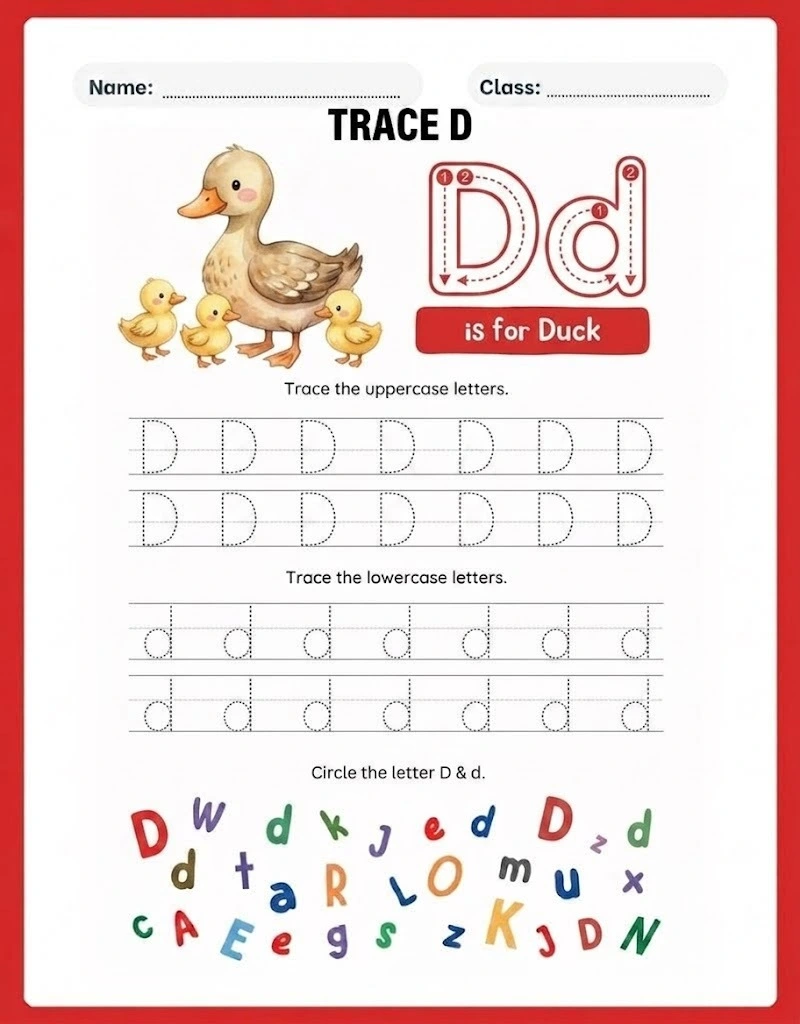
Learning to write letters takes practice, and the letter D gives young children a useful opportunity to work on both straight and curved lines. These Letter D tracing worksheets are designed to help preschool and kindergarten children become more familiar with uppercase D and lowercase d while developing early handwriting skills.
The printable pages provide guided opportunities to practice letter formation and can also connect the letter D with familiar beginning-sound words and pictures. This makes the activity useful not only for handwriting practice but also for reinforcing early alphabet and phonics skills.
Parents can use the worksheets for short practice sessions at home, while teachers and homeschool educators can include them in handwriting centers, letter-of-the-week lessons, morning work, or take-home practice.
What Is a Letter D Tracing Worksheet?
A Letter D tracing worksheet is a printable learning page that gives children guided practice forming the letter D. Instead of asking a beginning writer to create the letter completely from memory, tracing provides a visual path to follow.
The Letter D resources available on Superstar Worksheets include practice for both uppercase D and lowercase d, with guided formation and additional opportunities to trace and write the letters. Some pages also connect the letter with beginning-letter pictures and familiar D words.
For young learners, this type of activity can make handwriting practice less intimidating. Children can first follow a model, then gradually work toward forming the letter with less assistance.
What Children Can Learn With Letter D Tracing Worksheets
Letter tracing is more than simply following dotted lines. When children repeatedly practice a letter, they are working on several early-learning skills at the same time.
Letter Formation
Children become familiar with the shape and structure of uppercase D and lowercase d. Repeated practice can help them remember how the letters are formed.
Stroke Order
Guided examples can show children where to begin and how to move their pencil. Learning a consistent formation pattern is useful as children develop independent handwriting.
Uppercase and Lowercase Recognition
Young learners need to recognize that D and d represent the same letter even though their shapes are different.
Pencil Control
Tracing requires children to control the movement of a pencil or crayon while following a specific path. This gives them an opportunity to practice hand control and coordination.
Beginning-Letter Awareness
Letter D activities can also connect the written letter with words that begin with D. For example, children may encounter familiar D words such as dog, dinosaur, or duck.
Early Alphabet Practice
A focused letter worksheet can be useful when children are learning the alphabet one letter at a time or reviewing letters they have already introduced.
What Is Included in the Letter D Tracing Worksheets?
The Letter D tracing collection on Superstar Worksheets includes several types of D handwriting practice. The pages include uppercase and lowercase letter formation, large traceable letters, guided practice, and additional opportunities to work toward independent writing.
The collection includes resources such as:
- Large uppercase D tracing practice
- Large lowercase d tracing practice
- Guided uppercase letter formation
- Guided lowercase letter formation
- Trace-and-write practice
- Uppercase and lowercase letter practice
- Beginning-letter picture connections
- Additional letter D handwriting practice
The website also describes D-related picture examples including dog, dinosaur, and duck, which can help children connect the printed letter with familiar vocabulary.
Because individual pages can have different layouts and purposes, choose the worksheet that matches the child’s current level rather than expecting a child to complete every page at once.
Who Can Use These Letter D Worksheets?
Preschool Children
Preschoolers who are beginning to recognize letters can use large, simple tracing activities to become familiar with the shape of D and d.
At this age, keep practice sessions short. A child does not need to fill an entire page perfectly to benefit from the activity.
Kindergarten Children
Kindergarten students can use Letter D worksheets for handwriting review, uppercase and lowercase practice, beginning-sound reinforcement, or independent work.
The worksheets can also be useful when introducing D as part of an alphabet or phonics lesson.
Parents
Parents can print a worksheet for a quick home-learning activity. Five to ten minutes of focused handwriting practice can be easier for a young child than a long writing session.
Teachers
Teachers can use Letter D printables at writing centers, during alphabet instruction, as early-finisher work, or as supplemental handwriting practice.
Homeschool Educators
Homeschool families can include the pages in an alphabet unit, letter-of-the-week routine, or early handwriting lesson.
How to Use Letter D Tracing Worksheets
A little preparation can make a tracing activity much more effective.
1. Introduce the Letter
Before giving the worksheet to the child, show them uppercase D and lowercase d.
Say the letter name and, when appropriate, practice its sound together.
2. Model the Formation
Demonstrate the movement slowly. Let the child watch where you begin and how you move the pencil.
For uppercase D, a simple verbal cue can be:
“Line down, then make a big curve.”
For lowercase d, use the formation guide shown on the particular worksheet rather than relying on a memorized verbal instruction.
3. Let the Child Trace
Have the child follow the provided lines or dotted letters. Encourage slow, controlled movements rather than rushing from one letter to the next.
4. Practice With Less Support
Once the child becomes comfortable with the traced examples, encourage them to try writing the letter independently when the worksheet provides space for it.
5. Connect the Letter to a Word
Ask the child to name something that starts with D.
You could say:
“D is for dog. What other D words do you know?”
This turns handwriting practice into a short language activity.
6. Review Rather Than Drill
Return to the worksheet later instead of making the child repeat the same page for a long period.
Short, positive practice is usually easier for young children to manage.
Tips for Helping Children Complete the Worksheet
Start with large letters.
Large tracing examples give beginners more room to control their pencil movement.
Watch the starting point.
If the worksheet provides a starting dot, arrow, or numbered formation guide, encourage the child to follow it rather than simply copying the overall shape.
Don’t focus only on perfection.
Early handwriting is a developing skill. A slightly uneven letter is still part of the learning process.
Use the child’s preferred writing tool.
Pencils are useful for handwriting practice, while crayons can make the activity more inviting for younger children. Choose a tool that is comfortable for the child’s current fine-motor ability.
Practice uppercase and lowercase separately at first.
If the child is confused by D and d appearing together, spend a short session focusing on one form before introducing both.
Add movement away from the worksheet.
Ask the child to find objects around the room that begin with D. This gives the letter a purpose beyond the printed page.
Keep practice sessions manageable.
Young children often learn better through several short activities than one lengthy handwriting session.
Free Printable Letter D Tracing Worksheets
If you’re looking for printable Letter D practice, Superstar Worksheets provides a dedicated collection of Letter D Tracing Worksheets for young learners. The collection includes uppercase and lowercase practice, guided formation, and additional handwriting activities.
You can use the worksheets as part of:
- Preschool handwriting practice
- Kindergarten alphabet lessons
- Letter-of-the-week activities
- Homeschool lessons
- Classroom writing centers
- Take-home learning
- Beginning handwriting review
For printing, use the paper size recommended by your printer and the PDF or printable format provided on the worksheet page. If you plan to reuse a page, placing it inside a page protector can allow children to practice with a dry-erase marker when the worksheet design is suitable for that purpose.
For best results, preview the page before printing so you know which activity or level of handwriting support is appropriate for the child.
You can access the Letter C tracing resources here:
Get the Letter C Tracing Worksheets
Frequently Asked Questions
What age is a Letter D tracing worksheet suitable for?
Letter D tracing worksheets are generally useful for children in the preschool and kindergarten years who are beginning to recognize and write letters. The appropriate age depends on the child’s handwriting readiness and previous letter experience. Children who are new to writing may benefit from larger guided letters, while more confident writers can move toward less-supported practice.
How can I teach a preschooler to write letter D?
Start by introducing uppercase D and lowercase d visually. Show the child the formation slowly, then allow them to trace the provided examples. Encourage them to follow the starting point and direction shown on the worksheet. Keep the activity brief and positive, and connect D to familiar words such as dog, duck, or dinosaur.
Is Letter D tracing suitable for kindergarten?
Yes. Letter D tracing can be useful in kindergarten for introducing the letter, reviewing formation, practicing uppercase and lowercase recognition, and reinforcing beginning sounds. Children who already know how to form D can use tracing as a warm-up before moving to independent writing.
Should children practice uppercase D or lowercase d first?
There is no single rule that every child must follow. Many handwriting activities introduce uppercase and lowercase forms together so children learn that both represent the same letter. If a child finds this confusing, you can practice one form at a time before combining them.
How often should children practice letter D?
Short, repeated practice is usually more practical than one long session. You might use a Letter D worksheet for a few minutes during an alphabet lesson, then revisit the letter through reading, drawing, or word activities on another day. The amount of practice should match the child’s attention span and handwriting readiness.
What words can children learn with the letter D?
Children can practice familiar words beginning with D, such as dog, duck, dinosaur, and dice. Using pictures and spoken words alongside handwriting can help children connect the letter they see with vocabulary they already understand.
Can parents use Letter D worksheets at home?
Yes. Parents can use a printable worksheet as a simple addition to home learning. Before starting, briefly demonstrate the letter and explain what the child should do. After tracing, ask the child to identify the letter or name a D word to turn the worksheet into a short literacy activity.
Can teachers use these worksheets in the classroom?
Yes. Letter D tracing pages can fit into handwriting centers, alphabet lessons, morning work, early-finisher activities, or supplemental practice. Teachers can choose a worksheet that matches the student’s current level of support rather than assigning the same amount of tracing to every child.
What should children do after completing a Letter D tracing worksheet?
After tracing, give children another way to interact with the letter. They could find D words in a picture book, draw something beginning with D, identify uppercase and lowercase D, or practice writing the letter on a blank sheet. These follow-up activities help move the skill beyond tracing.