
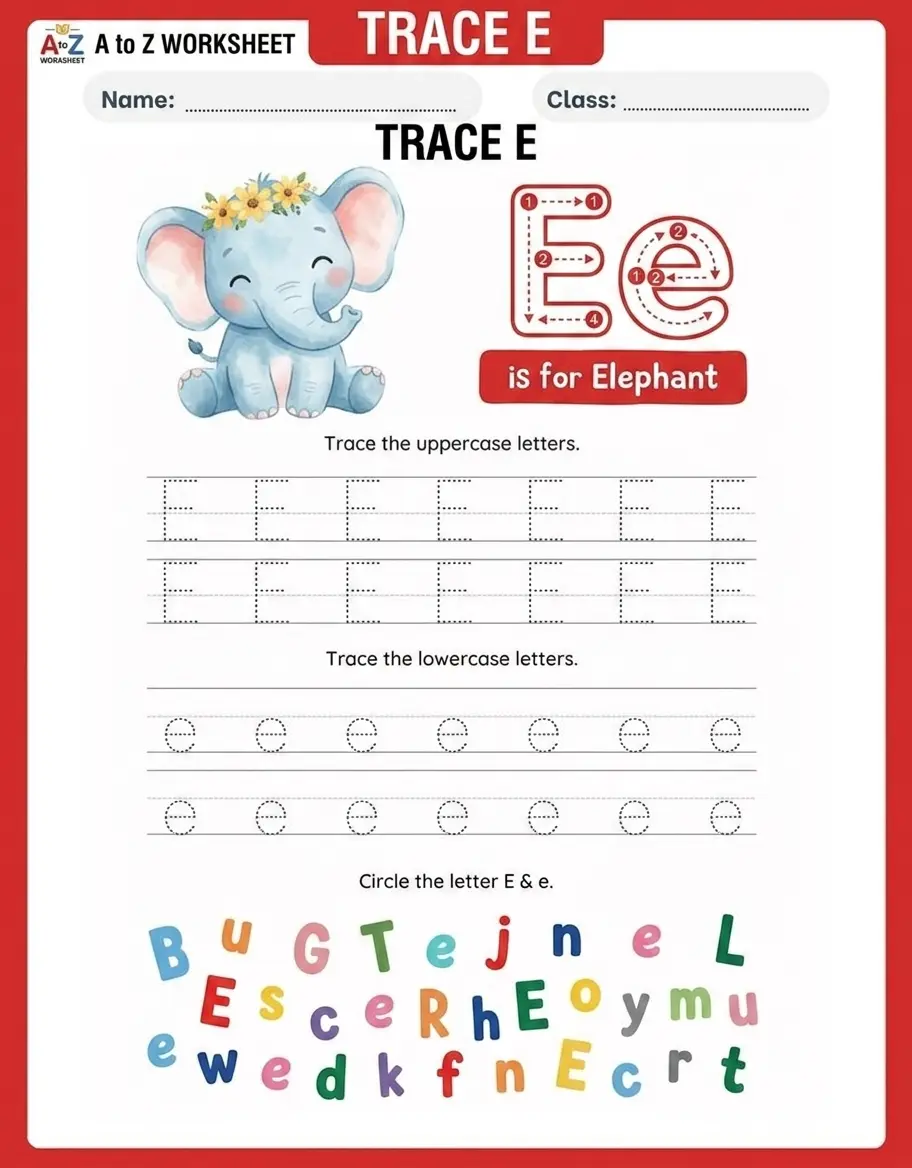
Learning to write the alphabet takes practice, patience, and plenty of opportunities for children to form letters with their own hands. Letter E tracing worksheets give preschool and kindergarten children a simple way to practice the shape and formation of E and e while developing early handwriting skills.
Tracing can be especially helpful for children who are still learning how to control a pencil and follow the correct path when forming letters. A printable worksheet also makes it easy for parents, teachers, and homeschoolers to add short handwriting practice to an existing alphabet lesson.
This Letter E resource can be used alongside other alphabet activities to help children become more familiar with the letter and build confidence as beginning writers.
What Is a Letter E Tracing Worksheet?
A Letter E tracing worksheet is a printable alphabet practice resource designed to give children repeated opportunities to work on the formation of the letter E.
Instead of asking a young child to write the letter independently right away, tracing provides a visual path to follow. Children can use their pencil to practice the movement needed to form the letter before attempting it on their own.
For preschool and kindergarten learners, this type of practice can support early handwriting development while reinforcing recognition of the letter E.
What Children Can Learn With Letter E Tracing Worksheets
Letter tracing is more than simply drawing over a letter. With regular, age-appropriate practice, children can work on several early learning skills.
Letter recognition
Repeated exposure to E and e helps children become more familiar with the letter’s appearance.
Letter formation
Tracing gives children an opportunity to practice the basic strokes and movement involved in forming the letter.
Pencil control
Following a letter path requires children to guide a pencil carefully rather than making random marks across the page.
Fine motor practice
Holding and controlling a pencil involves small hand and finger movements that are important for early writing activities.
Handwriting confidence
Children often feel more comfortable attempting independent writing after they have had guided opportunities to practice a letter.
What Is Included in the Letter E Tracing Worksheet?
The exact activities and illustrations should match the worksheet being provided. For an accurate description, use the worksheet image itself as the source rather than assuming that every Letter E worksheet contains the same activities.
If your printable contains multiple forms of letter practice, describe each activity specifically—for example, whether children trace uppercase E, lowercase e, follow dotted letter formations, color pictures, or complete another task.
Tip for the published page: Add a short visual description immediately below the worksheet preview so parents can quickly understand what their child will be doing before printing it.
Who Can Use This Worksheet?
Preschool children
Young learners who are beginning alphabet and pre-writing activities can use letter tracing as a guided introduction to letter formation.
Kindergarten children
Kindergarten students can use tracing worksheets as handwriting practice, especially when they are learning to form uppercase and lowercase letters more consistently.
Parents
Parents can use a printable worksheet for a short learning activity at home without needing to prepare a complicated lesson.
Teachers
Teachers can include letter tracing in literacy centers, handwriting practice, morning work, or small-group activities when appropriate for their classroom.
Homeschoolers
Homeschooling families can combine letter tracing with reading, phonics, alphabet games, and other early literacy activities.
How to Use a Letter E Tracing Worksheet
A worksheet works best when it is part of a short, focused learning activity rather than a long writing session.
1. Introduce the letter
Show the child the letter E and say its name clearly. Talk briefly about where they may see the letter in everyday words.
2. Look at the letter shape
Before tracing, give the child a moment to look at the letter. Point out its basic shape and explain where to begin if the worksheet provides a starting point.
3. Demonstrate the movement
Show the child how to follow the tracing path slowly. Young children often benefit from seeing the movement before trying it themselves.
4. Let the child trace
Allow the child to work through the worksheet at a comfortable pace. Encourage careful pencil movements rather than focusing on speed.
5. Try independent writing
Once the child is comfortable with tracing, provide blank space or another suitable writing surface for an independent attempt.
6. Review the letter
Finish by asking the child to identify E among other letters or find E in a familiar word. This connects handwriting practice with letter recognition.
Tips for Helping Children Complete the Worksheet
Keep practice sessions short. Young children can lose interest when handwriting practice goes on for too long. A few focused minutes may be more productive than forcing a lengthy session.
Demonstrate before correcting. If a child struggles with a stroke, show the movement again instead of repeatedly telling them that it is wrong.
Encourage a comfortable pencil grip. Children are still developing handwriting control, so avoid expecting perfect handwriting immediately.
Focus on progress. A child’s first attempts may look uneven. The goal is to give them repeated opportunities to practice.
Connect writing with other alphabet activities. After tracing E, children can look for the letter in books, identify it on alphabet cards, or practice saying words that begin with the /e/ sound when appropriate.
Use positive feedback. Comments such as “You followed the line carefully” are more useful than simply saying “Good job” because they tell children what they did well.
Free Printable Letter E Tracing Worksheets
A printable Letter E tracing worksheet can be a convenient addition to preschool or kindergarten handwriting practice. Parents and educators can print the resource and use it during a planned alphabet lesson, as independent practice, or as a short activity at home.
Before printing, check the worksheet’s intended page size and make sure your printer is set to the appropriate paper setting. Avoid enlarging or shrinking the page unnecessarily if doing so could affect the worksheet’s layout.
For repeated practice, consider printing an additional copy rather than asking a child to complete the same page repeatedly. This keeps each practice session fresh and gives children another opportunity to work on letter formation.
You can access the Letter E tracing resources here:
Get the Letter E Tracing Worksheets
Frequently Asked Questions
What age is a Letter E tracing worksheet suitable for?
Letter E tracing worksheets are generally most useful for young children who are beginning alphabet and handwriting practice, particularly preschool and kindergarten learners. The right age varies from child to child. Some children may enjoy tracing earlier, while others need more time with pre-writing activities before working on letter formation.
How can I teach a child to write the letter E?
Start by showing the child the letter and demonstrating how it is formed. Let the child trace a guided version before asking them to write it independently. Short, regular practice is usually easier for young learners than long writing sessions.
Is a Letter E worksheet suitable for kindergarten?
Yes. Letter E tracing can be used as handwriting practice for kindergarten children who are learning or reinforcing alphabet letter formation. Teachers can combine tracing with letter recognition, phonics, reading, and independent writing activities.
How can preschoolers practice the letter E at home?
Children can practice E through several simple activities, including tracing worksheets, finding E in picture books, identifying the letter on alphabet cards, building the letter with play materials, and practicing writing on paper or a suitable writing surface.
Should children practice uppercase E or lowercase e first?
This depends on the child’s learning stage and the sequence being used by the parent, teacher, or curriculum. If the worksheet includes both forms, children can gradually become familiar with the visual differences between uppercase E and lowercase e.
How often should children use tracing worksheets?
There is no single practice schedule that works for every child. Short sessions several times a week can provide opportunities to reinforce letter formation without making handwriting feel tiring. Adjust the amount of practice according to the child’s age, attention span, and comfort.
What pencil should a preschool child use?
A pencil or other writing tool that the child can comfortably hold and control is generally appropriate. For younger children, a thicker writing tool may sometimes feel easier to manage. The most important consideration is that the child can use it comfortably while practicing controlled movements.
What should I do if my child struggles with tracing?
Slow down and demonstrate the letter again. Check that the child understands where to begin and which direction to move. If tracing is still difficult, return to simpler pre-writing activities such as lines, curves, and controlled strokes before trying the letter again.