
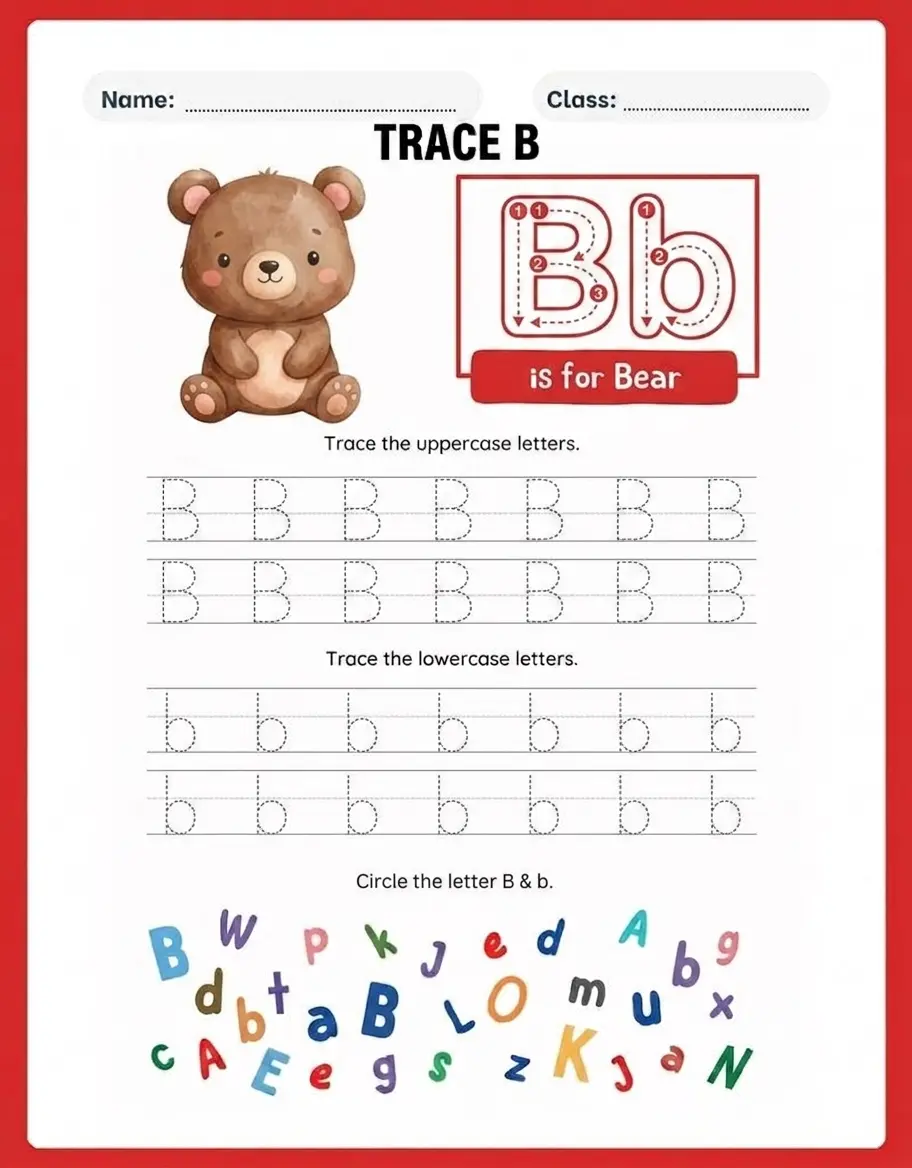
Learning to write letters takes plenty of repetition, especially for young children who are still developing pencil control. Letter B tracing worksheets give children a simple way to practice forming the letter while becoming more familiar with its shape.
These worksheets can be useful for preschoolers beginning alphabet writing as well as kindergarten children who need additional handwriting practice. Parents can use them during short learning sessions at home, while teachers and homeschool educators can include them as part of an alphabet or early-literacy lesson.
The goal isn’t to rush through a page. A few focused minutes of careful tracing can give a child useful practice with letter formation and handwriting control.
What Is a Letter B Tracing Worksheet?
A letter B tracing worksheet is a printable learning activity designed to help children practice forming the letter B/b.
Tracing provides a visual model that children can follow with a pencil, crayon, or another suitable writing tool. Instead of having to remember the complete shape of the letter immediately, children can follow the provided formation pattern and gradually become more comfortable writing it independently.
For early learners, repeated practice can also help connect the letter’s appearance, name, and written form.
The exact activities included on a particular worksheet depend on its design. Parents and teachers should look at the worksheet itself to determine which exercises are available.
What Children Can Learn With This Worksheet
Letter B handwriting practice can support several early-learning skills:
- Letter recognition: Children become more familiar with the shape of B and b.
- Letter formation: Tracing gives children a model to follow when practicing how the letter is written.
- Pencil control: Following lines requires controlled hand and finger movements.
- Handwriting confidence: Repeated practice can make unfamiliar letters feel easier.
- Alphabet practice: The activity can fit naturally into a broader alphabet-learning routine.
- Visual attention: Children need to watch the letter shape and follow the intended path.
Tracing is most useful when it is combined with opportunities to recognize and eventually write the letter without a guide.
What Is Included in the Letter B Tracing Worksheet?
The specific activities should be described according to the actual worksheet design.
For this page, avoid adding claims about coloring, matching, pictures, beginning-sound exercises, or other activities unless they are visibly included on the worksheet.
If the worksheet contains uppercase and lowercase B tracing, for example, the description can explain that children practice both forms. If it contains additional writing exercises, those should be described separately and accurately.
This approach keeps the page useful for visitors while avoiding misleading descriptions of the downloadable resource.
Who Can Use This Worksheet?
Preschool Children
Many preschool children are beginning to recognize letters and experiment with writing them. A tracing activity can provide a manageable introduction to letter formation.
Short sessions are usually more appropriate than expecting a young child to complete a large amount of handwriting practice at once.
Kindergarten Children
Kindergarten students can use letter B worksheets as additional handwriting practice, alphabet review, or independent seatwork.
Teachers may also use them when introducing or reviewing the letter B during an alphabet lesson.
Parents
Parents can add a tracing worksheet to a simple home-learning routine. It can be used alongside reading alphabet books, identifying letters in everyday objects, or practicing letter sounds.
Homeschool Educators
For homeschool lessons, the worksheet can become one small part of an alphabet unit rather than the entire lesson.
How to Use This Worksheet
A simple routine can make tracing practice more productive.
1. Introduce the Letter
Before starting the worksheet, show the child the letter B and say its name clearly.
If appropriate for the child’s level, talk about the difference between uppercase B and lowercase b.
2. Demonstrate the Formation
Show the child how to follow the tracing path rather than simply completing the page for them.
Use slow movements so the child can watch the direction of the pencil.
3. Let the Child Trace
Allow the child to work through the worksheet at their own pace.
If the child struggles, guide their hand or demonstrate one example, then let them try again.
4. Encourage Careful Practice
Focus on controlled movements rather than speed. Young children are still developing the fine-motor skills needed for handwriting.
5. Move Toward Independent Writing
Once a child becomes comfortable tracing B, provide opportunities to copy or write the letter without tracing lines.
This helps turn guided practice into independent handwriting.
Tips for Helping Children Complete the Worksheet
Keep practice sessions short. Young children may lose concentration during long handwriting activities. A short, focused session can be more useful than repeatedly asking them to continue.
Use the right writing tool. Choose a pencil, crayon, or other writing tool that the child can comfortably control.
Watch the grip without constantly correcting it. If the child’s grip is uncomfortable or makes writing difficult, gently demonstrate a more functional position.
Praise effort rather than perfection. Saying “You followed the shape carefully” gives more useful feedback than simply saying “Good job.”
Don’t turn tracing into a race. Accuracy and control matter more than finishing quickly.
Give children breaks. If their hand becomes tired or they become frustrated, pause and return to the activity later.
Free Printable Letter B Tracing Worksheets
A printable letter B worksheet can be convenient for home learning, classroom practice, and homeschool activities.
Before printing, check the worksheet’s intended page dimensions and printer settings. Letter size is commonly used in the United States, while A4 is common in many other countries. Use the actual file’s dimensions rather than assuming one format if the website provides a specific printable size.
For handwriting practice, ordinary printer paper may be sufficient. If a child tends to press heavily with a pencil or crayon, slightly heavier paper can also be considered.
Parents and teachers can print additional copies when children benefit from repeated practice. However, the worksheet works best as one part of a broader literacy routine that includes reading, speaking, listening, letter recognition, and independent writing.
Get the Letter B Tracing Worksheets:
Letter B Tracing Worksheets
Frequently Asked Questions
What age is a letter B tracing worksheet suitable for?
Letter B tracing activities are generally most relevant to children who are beginning alphabet and handwriting practice, often during the preschool and kindergarten years. Readiness varies from child to child, so the best indicator is whether the child can hold a writing tool and is interested in practicing simple letter shapes.
How can I teach my child to write the letter B?
Start by helping your child recognize the letter and distinguish uppercase B from lowercase b. Demonstrate the writing movement slowly, then let the child trace it. After guided practice, encourage the child to copy the letter and eventually write it independently.
Is a letter B worksheet suitable for kindergarten?
Yes. Kindergarten children can use letter B worksheets for alphabet review, handwriting practice, or additional practice after a letter has been introduced. Children who already recognize B may benefit from focusing more on accurate formation and independent writing.
How can preschoolers practice the letter B at home?
Keep the practice playful and brief. Children can look for B in books, identify objects beginning with the /b/ sound when appropriate, say the letter name, trace it, and practice writing it. A printable worksheet can provide structured handwriting practice within this routine.
Should children practice uppercase or lowercase B first?
There isn’t one universal order that works for every child. Many early-learning programs introduce uppercase and lowercase forms together or introduce uppercase letters first. Follow the sequence used in your child’s classroom or curriculum when possible.
How often should children practice letter tracing?
There is no need to complete a large amount of tracing every day. Short, regular sessions can provide useful practice. If a child becomes tired or frustrated, stop and return to handwriting another time rather than turning the activity into a struggle.
What writing tools can children use with a tracing worksheet?
A pencil is a natural choice for handwriting practice, while crayons can work well for younger children who are still developing control. The best option depends on the child’s age, motor skills, and the design of the worksheet.
What should children do after tracing B?
After tracing, encourage children to look at the letter and try copying it without the guide. They can also practice identifying B in books or environmental print. These activities help connect tracing practice with actual letter recognition and independent writing.