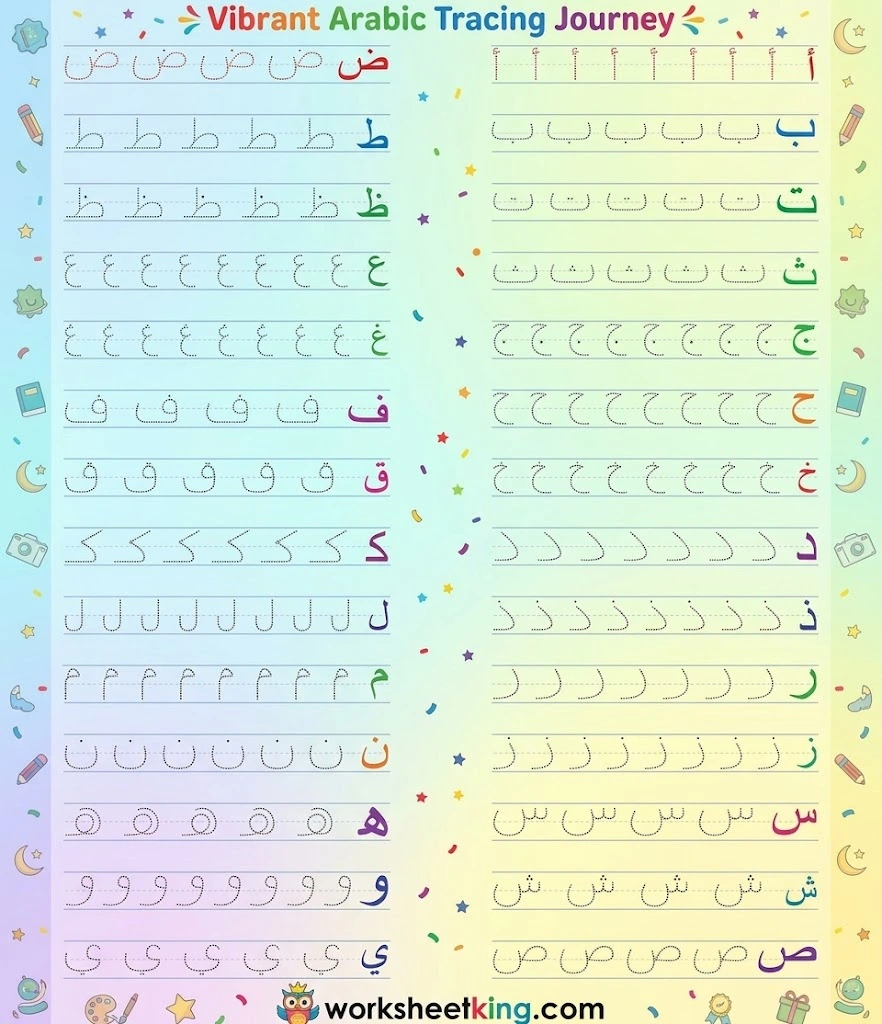
Learning to write a new alphabet takes patience and plenty of practice. For young children, tracing can be a simple way to become familiar with the shapes of Arabic letters while developing early handwriting control.
These Arabic alphabet tracing worksheets for kids are designed as a practical learning resource for children who are beginning to recognize and practice Arabic letters. Parents can use them during short home-learning sessions, while teachers and homeschoolers can include them as part of an Arabic language or early-writing lesson.
The Arabic alphabet contains 28 letters, beginning with Alif (ا) and ending with Ya (ي). Unlike the English alphabet, Arabic is written from right to left, so children are learning both unfamiliar letter shapes and a different writing direction.
A tracing worksheet gives children an opportunity to look carefully at each letter and practice following its shape with a pencil or other writing tool. For beginners, this can make the first steps toward Arabic handwriting feel more manageable.
What Is an Arabic Alphabet Tracing Worksheet?
An Arabic alphabet tracing worksheet is a printable learning activity that gives children guided practice with Arabic letters.
Instead of asking a young learner to write an unfamiliar letter completely from memory, tracing provides a visual model to follow. The child can concentrate on the shape of the letter and the movement needed to reproduce it.
For children who are just starting Arabic writing practice, this type of activity can be used alongside letter recognition, pronunciation practice, picture-based activities, books, songs, or other language-learning activities.
A useful starting point is to introduce only a small amount of practice at a time. Young children generally benefit more from a short, focused activity than from being expected to complete a large amount of writing in one sitting.
What Children Can Learn With Arabic Letter Tracing
Tracing is more than simply filling a page. When used thoughtfully, it can support several parts of early writing practice.
Letter recognition
Children can become more familiar with the visual appearance of Arabic letters as they repeatedly see and trace them.
Letter formation
Tracing gives children a model for the basic shape of a letter before they attempt to reproduce it independently.
Pencil control
Following a letter outline requires children to control the movement of a pencil or crayon. This can provide useful early writing practice.
Visual attention
Children need to look closely at curves, lines, dots, and other features that distinguish one Arabic letter from another.
Early handwriting confidence
A guided activity can feel less difficult than starting with a blank page. Once a child becomes comfortable tracing, parents or teachers can gradually introduce independent writing practice.
Familiarity with the Arabic alphabet
Repeated exposure can help children become more comfortable with the sequence and appearance of Arabic letters.
Tracing should be viewed as one part of learning rather than the entire learning process. Children can also benefit from hearing the letters pronounced, seeing them in words, and using them in simple language activities.
What Is Included in the Arabic Alphabet Tracing Worksheet?
This resource is intended for Arabic letter tracing practice, focusing on the letters of the Arabic alphabet.
Because the exact design of a worksheet can vary, parents and teachers should look at the individual pages to see how much tracing and independent writing space is provided.
The key purpose of the activity is straightforward: children see an Arabic letter and practice following its form.
If the worksheet contains the complete Arabic alphabet, it can provide practice from Alif (ا) through Ya (ي). Arabic has 28 letters, so describing the resource as an “Arabic A–Z worksheet” can be confusing for parents searching specifically for Arabic-language learning materials. “Arabic alphabet tracing worksheet” is a more accurate description.
Who Can Use These Arabic Tracing Worksheets?
Preschool children
Young children beginning to learn Arabic can use tracing activities as an introduction to Arabic letter shapes and early writing movements.
The adult helping the child can keep sessions short and focus on a few letters at a time rather than expecting the child to complete everything in one sitting.
Kindergarten children
Kindergarten learners who already recognize some Arabic letters can use tracing as additional handwriting practice.
It can also work as a quiet independent activity after a teacher has introduced the letters during a lesson.
Parents
Parents can use printable Arabic worksheets for short learning sessions at home. The worksheet does not have to replace a structured Arabic lesson; it can simply provide additional practice.
Teachers
Teachers can include tracing worksheets as part of classroom handwriting practice, language centers, or individual practice time.
Homeschoolers
For homeschooling families, an Arabic alphabet worksheet can be combined with reading, pronunciation, vocabulary, and handwriting activities to create a more complete lesson.
How to Use This Arabic Alphabet Tracing Worksheet
A simple routine can make tracing practice more productive.
1. Introduce the letter
Before handing over the worksheet, show the child the letter and say its name. Give the child time to look at its shape.
2. Demonstrate the movement
Use your finger to slowly follow the letter before asking the child to pick up a pencil.
This gives the child a chance to observe the movement without worrying about making a perfect mark.
3. Let the child trace
Allow the child to follow the worksheet’s tracing guide at their own pace.
Try not to move the child’s hand constantly. Instead, give a simple reminder when they lose track of the shape.
4. Say the letter aloud
Where appropriate, say the letter while the child traces it. Connecting what children see with what they hear can make the activity more meaningful.
5. Review rather than rush
At the end of the activity, briefly review the letter. Ask the child to point to it or identify it among a small selection of letters.
6. Repeat on another day
Children do not need to master every letter immediately. Repeated short practice sessions can be more manageable than one long worksheet session.
Tips for Helping Children Complete Arabic Letter Worksheets
Start with a few letters.
If your child is completely new to Arabic, avoid turning the worksheet into a race through the entire alphabet. Introduce a small number of letters and revisit them regularly.
Focus on the process, not perfect handwriting.
Early learners are still developing pencil control. A slightly uneven tracing attempt is part of learning.
Use a comfortable writing position.
Make sure the child has enough table space and can hold the pencil comfortably.
Say the letter while practicing.
Pairing the visual letter with its name or sound can add a language-learning element to the handwriting activity.
Watch for confusion between similar-looking letters.
Some Arabic letters share similar basic shapes but differ in their dots. Encourage children to look carefully rather than relying only on the overall outline.
Keep sessions short.
If a child becomes frustrated or tired, stop and continue another time. Worksheet practice should remain manageable and positive.
Mix worksheet work with other activities.
Try combining tracing with reading Arabic books, letter cards, oral practice, songs, or simple games.
Free Printable Arabic Alphabet Tracing Worksheets
If your Worksheet King resource is offered as a free printable, this section can introduce the download naturally without making the page feel like an advertisement.
Parents and teachers can print the worksheet and use it for additional Arabic writing practice at home or in the classroom. Before printing, check the worksheet’s actual file specifications and choose the paper size and print settings recommended for the resource.
For younger children, a pencil or age-appropriate writing tool is usually enough for tracing practice. If the worksheet is designed for repeated use, teachers and parents may also choose a reusable setup, provided the worksheet format and printing method support it.
Download the worksheet here: [ADD YOUR ACTUAL DOWNLOAD URL]
If the resource is not free, replace this heading with “Printable Arabic Alphabet Tracing Worksheets” and clearly explain whether the worksheet is available as a paid or downloadable resource.
Frequently Asked Questions
What age is an Arabic alphabet tracing worksheet suitable for?
Arabic tracing worksheets are generally most useful for children who are beginning to recognize and write Arabic letters. Preschool and kindergarten learners can use them with adult guidance, while older beginners may also find tracing useful when starting Arabic handwriting. The appropriate age depends on the child’s previous exposure to Arabic and their fine-motor development.
How can I teach Arabic letters to a preschooler?
Begin with a small number of letters rather than introducing the entire alphabet at once. Show the child each letter, say its name, let them look at its shape, and then practice tracing it. You can reinforce the lesson with books, songs, flashcards, or simple games involving the same letters.
Can kindergarten children use Arabic tracing worksheets?
Yes. Arabic tracing worksheets can be useful for kindergarten children who are learning Arabic letter recognition and early handwriting. Children who already know some letters can use tracing as additional writing practice, while beginners may need more adult guidance during the activity.
How can children practice Arabic writing at home?
A simple home routine can include looking at a letter, saying its name, tracing it, and then attempting to write it independently when the child is ready. Keep practice sessions short and consistent. Combining handwriting worksheets with Arabic reading and speaking activities can make the learning experience more varied.
How should I print an Arabic tracing worksheet?
Use the print settings recommended for the particular worksheet. If the resource specifies A4 or US Letter, select the corresponding paper size and check the print preview before printing. Printing at the worksheet’s intended scale can help preserve the spacing and writing areas.
How often should children practice Arabic handwriting?
There is no single schedule that works for every child. Short, regular practice can be a practical approach for young learners. If a child is becoming tired or frustrated, take a break rather than continuing simply to finish a page. The goal is meaningful practice, not completing as many worksheets as possible.
Is tracing enough to learn the Arabic alphabet?
Tracing is useful for practicing letter shapes and early handwriting, but it should not be the only learning activity. Children also need opportunities to recognize letters, hear and say them, and eventually use them in words. Combining tracing with other Arabic language activities gives children a broader learning experience.
How can I make Arabic tracing more engaging?
Keep the activity interactive. Say the letter together, ask the child to find the same letter elsewhere on the page, or connect the letter to something they already know. You can also alternate worksheet practice with stories, songs, letter cards, and verbal activities to prevent handwriting practice from becoming repetitive.
Are Arabic tracing worksheets useful for homeschool?
Yes. A tracing worksheet can fit easily into a homeschool Arabic lesson as a focused handwriting activity. Parents can introduce a letter, practice its pronunciation, complete a short tracing exercise, and then reinforce the same letter through reading, vocabulary, or a simple game.
Conclusion
Learning to write Arabic takes time, and young children need opportunities to see and practice letters repeatedly. Arabic alphabet tracing worksheets for kids can provide a simple starting point for developing familiarity with Arabic letter shapes and early handwriting movements.
For the best results, use tracing as one part of a broader learning routine. Combine worksheet practice with speaking, listening, reading, and other hands-on activities. Most importantly, let children work at a comfortable pace and celebrate progress as they become more confident with each new letter.
If you’re building an Arabic learning collection on Worksheet King, this worksheet can also become part of a larger library of preschool, kindergarten, alphabet, writing, and language-learning printables.